MEXT Scholarship from India: The Complete Guide (2028 Intake)
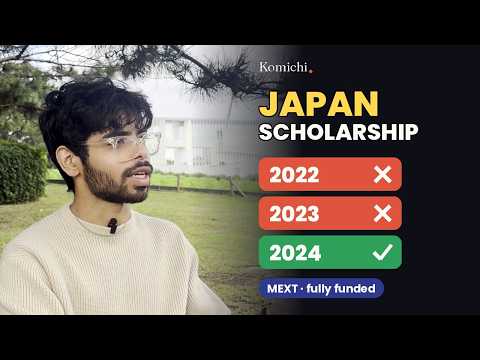
Imagine studying for a master's at a Japanese university where you pay zero tuition, receive ¥144,000 a month to live on, and get your flights paid each way — with no loan, no bond, and no obligation to work for anyone afterward. That's the MEXT scholarship, Japan's government scholarship, and it is one of the most generous fully-funded awards in the world.
It is also harder to win than most Indian coverage admits. For the 2027 research round, the Embassy of Japan in New Delhi received 7,303 applications and shortlisted 186 for the written test and interview — about one in forty before the worldwide screening in Tokyo even begins. This guide gives you the honest version: what MEXT actually pays, what it does not pay, what the real odds look like, and exactly where the cycle stands today.
Key takeaway: MEXT waives tuition, admission and examination fees entirely, pays a monthly stipend of ¥117,000 (undergraduate, KOSEN, specialised training) or ¥143,000–145,000 (research students — ¥144,000 on a master's course, ¥145,000 on a doctoral course), and covers economy airfare each way. There is no repayment and no service obligation. The 2027 embassy cycle closed on 15/25 May 2026 and nothing has been announced for 2028 yet — on the published pattern, expect the call around April–May 2027, with the Embassy of Japan in India (not MEXT in Tokyo) as your application point. It is competitive, not undersubscribed: 7,303 Indians applied for the 2027 research round.
Where the cycle stands right now
This is the first thing to establish, because a lot of what you'll read online is describing a window that has already shut.
- The 2027 intake is closed. The Embassy of Japan in India's scholarship page, updated 6 August 2026, marks Research Students, Undergraduate, KOSEN and Specialized Training College all as "Applications closed for 2027." Japanese Studies, Young Leaders' Program and Teacher Training are marked closed for 2026.
- Nothing has been published for 2028. As of today there is no 2028 announcement, notice or date on Study in Japan, MEXT, the Embassy in New Delhi, or any of the four consulates in India. We are not going to invent one.
- What the pattern says. Study in Japan describes the general rhythm plainly: for grantees arriving the following April, "recruitment… is made between April and May of the previous year," with first screening by the embassies and consulates between May and August. The 2027 cycle followed it exactly — the Embassy's call opened 20–23 April 2026. So plan for April–May 2027, and confirm on the Embassy's own page rather than on any third-party guide, this one included.
- If you applied for 2027, here is where you are. Research applicants have finished the written test (5 July 2026) and interviews (16–19 July). The window for approaching universities to request a letter of provisional acceptance closed on 1 September 2026 — MEXT's guidelines state that contacting universities from 2 September onward is not permitted. (That is the deadline to ask; it is explicitly not a deadline for the university to issue the letter.) You are now in the placement-preference window, which the official process chart puts at mid-September to early October 2026, with MEXT's second screening and university placement from November 2026 and results between January and early March 2027. Undergraduate, KOSEN and Specialized Training applicants who passed the first screening in late July are awaiting MEXT's second screening; those results are notified after February 2027.
If you are reading this in late 2026 aiming at a Japanese master's, the practical answer is: you have roughly six months to build the application MEXT actually rewards — and, separately, a university-recommendation route that runs on a different calendar and may open sooner.
What MEXT actually pays
These are the published figures, taken from the 2027 application guidelines and the Study in Japan scholarship page — not from scholarship-aggregator sites, which routinely attach the research-student figure to undergraduates.
| Category | Monthly stipend | ≈ in ₹ (at ₹0.6111) |
|---|---|---|
| Undergraduate · KOSEN · Specialized Training · Japanese Studies | ¥117,000 | ~₹71,500 |
| Research student — preparatory education / non-degree | ¥143,000 | ~₹87,400 |
| Research student — master's or professional degree course | ¥144,000 | ~₹88,000 |
| Research student — doctoral course | ¥145,000 | ~₹88,600 |
(The Embassy of Japan in India's own undergraduate page converts ¥117,000 as "approximately Rs.68,800" — the difference from our ~₹71,500 is simply the exchange rate on the day. Both are approximations; the yen figure is the one that's guaranteed.)
The regional supplement, stated correctly. MEXT adds ¥2,000 or ¥3,000 per month for grantees "studying or conducting research in specially designated regions." This is not, as many guides claim, a top-up for expensive cities — Tokyo is not a designated region, and MEXT does not publish which regions are, or which get ¥2,000 versus ¥3,000. Treat it as a possible small bonus, not part of your budget.
Both guidelines also carry a sentence worth noting: "Due to the situation of the Japanese Government's budget, the amount of payment may be subject to change each fiscal year."
On top of the stipend, MEXT covers:
- Tuition, admission and examination fees — waived entirely. One caveat for research students: the entrance examination fee "will be borne by the grantees if they cannot proceed to the master's or doctoral course or cannot be admitted to the university."
- Airfare — one economy round trip. Arrival and return, from the international airport nearest your residence to a Japanese international airport on the normal route to your university.
- A one-year Japanese-language preparatory course for embassy-route undergraduates. Note the default: the guidelines say that as a rule each grantee is enrolled at a preparatory institution for the first year — it is skipped only through direct placement, which is why the embassy-route undergraduate award runs five years rather than four.
- No repayment, no bond, no obligation to work in Japan afterward — though the door to working in Japan after study is wide open if you want it.
What MEXT does NOT cover — and most Indian guides get this wrong:
- Insurance. You enrol in Japan's National Health Insurance (国民健康保険) yourself on arrival and pay the premiums. Travel insurance for the flight is explicitly at your expense.
- Accommodation. University residence halls may be available, but the guidelines are blunt: "Expenses relating to accommodations will be borne by the grantee." Rent comes out of the stipend.
- Domestic travel to and from the airport, airport taxes, special travel taxes, travel within Japan, and excess or unaccompanied baggage.
- Your first few weeks. MEXT recommends bringing at least about US$2,000, because the first stipend payment lands one to one and a half months after you arrive. Budget for that gap.
Even after those exclusions, the stipend comfortably covers a student's living costs in most Japanese cities. JASSO's national survey of privately-financed international students puts average total monthly spending at ¥170,000 — but that figure includes tuition and study costs, which MEXT has already removed from your bill. Our cost-of-living breakdown in ₹ and the full cost comparison against Canada, Germany and Australia have the detail. This is why MEXT students routinely graduate with savings rather than debt.
The condition nobody tells you about: you have to keep it
MEXT is a continuing award, not a one-time approval — and this is the single most common omission in Indian coverage of it.
MEXT's own rule is qualitative, not a number. Payment is suspended when it becomes impossible to complete the programme within the standard period because of poor academic grades. Your university reports your academic record to MEXT once a year, and it is that report the decision rests on.
Your university's rule may well be a number. The University of Tokyo's published rules for MEXT scholarship students set an explicit threshold — scholars on the university-recommendation track "must keep on average of over a 2.3 of Japanese GPA" on Japan's 3.0 scale (A+/A 優 = 3, B 良 = 2, C 可 = 1, F 不可 = 0). For scholars on other tracks the same document says the record is simply reported annually, without a stated cut-off. So do not assume 2.30 applies to you, and do not assume no number applies either — it depends on your university and your track.
Two further consequences are set out plainly, and they apply regardless:
- Taking a leave of absence (休学) forfeits eligibility.
- The scholarship cannot be extended beyond the standard period of your programme to let you finish late.
The practical instruction is the same in every case: ask your international office for their written MEXT scholarship rules in your first week — before you choose your courses, not after. Get the threshold, the reporting date and the consequence in writing.
How competitive is it, really?
The honest answer has changed since the last version of this guide, which described MEXT as "genuinely undersubscribed by Indian students." The Embassy's own published shortlist for the 2027 research round says otherwise:
"The Embassy received 7,303 applications, and out of which following 186 applicants have been shortlisted for a written test and interview based on the screening of their Preliminary Application Forms."
That is a 2.5% shortlist rate — and the shortlist is only the first screening. Those 186 then sat the written test and interview, had to secure a letter of provisional acceptance from a Japanese university, and pass MEXT's worldwide final screening in Tokyo.
Read that last clause carefully, because it changes how you should prepare. The cut from 7,303 to 186 is made on the Preliminary Application Form alone — the Embassy states that no supporting documents are submitted with it, and the full application pack is requested only from those already shortlisted. So your research plan, your recommendation letter and your professor's interest decide nothing at the first gate. Your academic record and how well you fill in that preliminary form are what get you into the 186. Everything else decides what happens afterwards.
The undergraduate-level categories are smaller and just as tight. The Embassy's 2027 pages for Undergraduate, KOSEN and Specialized Training College each state the same quota: "Up to 12 (approximately 12 applicants who successfully pass the first screening will proceed to the worldwide final screening by MEXT)."
Two things follow. First, stop treating MEXT as a lottery ticket you buy cheaply — with 7,303 applicants competing on marks and a form, a careless preliminary application is simply discarded. Second, build a fallback in parallel. Scholarships beyond MEXT — JASSO, JICA, Rotary Yoneyama, prefectural and university awards — are less contested, and our scholarship finder and study-for-free playbook map the combinations that get people to near-zero cost without MEXT. That matters more than it sounds: only 2,095 Indian students were enrolled in Japan as of 1 May 2025, and most of them are not on MEXT.
The two routes — and which one is yours
1. Embassy Recommendation — the main route for Indians. You apply through the Embassy of Japan in New Delhi or the Consulate for your region. The embassy screens, tests, interviews and shortlists; MEXT in Tokyo does the final screening and placement. Compared side by side on our embassy-track page.
A practical warning about the consulate websites, verified today: several old MEXT pages are still live, and a search engine will happily send you to one. The Mumbai consulate's dedicated undergraduate MEXT page is dated 2021 and still describes the 2022 intake, with a deadline of 28 May 2021 and an age cut-off of 1997. The Bengaluru consulate has a page from 2019 describing the 2020 intake — it is marked 【CLOSED】, but it is still reachable. Both consulates do have current material elsewhere: Mumbai's culture-and-education hub (updated June 2026) links the Embassy's 2027 pages, and Bengaluru's studying-in-Japan page carries the MEXT 2027 preliminary-screening results. Kolkata and Chennai both published clearly dated 2027 notices.
The rule that follows is simple: check the date stamp on any page before you plan around it, and treat the Embassy's own category pages in New Delhi as canonical. Where a consulate page and the Embassy page disagree — on the deadline, the submission method or the submission address — write to them and ask before you act. One live example of exactly that: the Embassy's undergraduate, KOSEN and specialised-training pages state that applications sent by email are not accepted, while the Kolkata consulate's own 2027 notice gave an email address for submissions. Follow the instruction from the office you are actually submitting to.
2. University Recommendation. A Japanese university nominates you to MEXT directly, usually under a student-exchange agreement with an overseas institution. MEXT's description is specific: "only a select number of universities approved by MEXT can make recommendations," and "not all universities… maintain their own recommendation quotas." Three things make this route different, and for some applicants better:
- No MEXT subject exams. You go through the university's own admissions process instead of the embassy's written papers.
- A different calendar. University-recommended grantees "usually arrive in Japan in September or October, but some arrive in late March or early April" — so the deadlines are not April–May, and there is no central deadline at all. Each university runs its own.
- For undergraduates, normally no preparatory year. The embassy route's undergraduate award runs five years including Japanese-language training; the university route runs "6 months up to standard school years" with "normally, there is no preliminary education."
The catch is finding a university with a quota and a place for you. Our university-track page lists what we've verified, and the route usually begins with a supervising professor — see contacting a professor in Japan.
There is also a Domestic route for people already in Japan, which won't apply to most readers.
Am I eligible? The published limits
Research Students (master's, PhD, and non-degree research):
- Age: born on or after 2 April 1992 — in practice, under 35.
- Academic: 16 years of schooling, or a three-year-plus programme with a bachelor's-equivalent degree, or other eligibility for Japanese graduate enrolment. Doctoral second-phase applicants need a master's-equivalent degree or two years of post-graduation research. Medicine, dentistry, veterinary and some pharmacy doctorates need 18 years of schooling or a five-year-plus programme.
- India-specific: the Embassy requires a minimum of 70% in the relevant bachelor's degree — 65% for humanities and social sciences — and, for doctoral second-phase applicants, 70% in the master's as well.
Undergraduate Students:
- Age: born on or after 2 April 2002 — in practice, under 25. Applicants qualifying through the equivalency route must be 18 or older at the time of admission.
- Academic: 12 years of school education completed outside Japan (prospective graduates included), or a recognised equivalent.
- India-specific: a minimum of 80% in Grade 12 — or 80% in Grade 10 plus a school certificate projecting above 80%.
KOSEN (College of Technology) and Specialized Training College are the vocational and technical routes, both at the ¥117,000 stipend.
The 2027 timeline — use it as the template for 2028
Nothing is published for 2028 yet, so the most useful thing we can give you is exactly how the last cycle ran. Expect the same shape, roughly a year later, and confirm every date against the Embassy.
| Stage | Research Students | Undergraduate | KOSEN / Specialized Training |
|---|---|---|---|
| Application window | 20 April – 15 May 2026 | 23 April – 25 May 2026 | 23 April – 25 May 2026 |
| How to submit | Preliminary form by email (MS Word, max 1 MB) | By post, courier or in person — email not accepted | By post, courier or in person |
| Written examination | 5 July 2026 | 20 June 2026 | 12 July 2026 |
| Interview | 16–19 July 2026 (online) | 22 June 2026 (online) | 15 July 2026 (online) |
| First-screening result | Shortlist notified early June; test/interview follow | End of July 2026 | End of July 2026 |
| Securing a university | Must approach universities by 1 Sep 2026 (not a letter-issuance deadline) | Placement handled through MEXT | Placement handled through MEXT |
| MEXT second screening | From November 2026 | After February 2027 | After February 2027 |
| Final result & placement | January – early March 2027 | After February 2027 | After February 2027 |
| Arrival in Japan | April 2027 | April 2027 | April 2027 |
Two mechanics from the research guidelines worth knowing before you need them: you may hold a maximum of two letters of provisional acceptance, list a maximum of three universities, and approach no more than two universities at the same time. Plan the outreach sequence early — there is no time to restart it in August.
The application, step by step
- Check eligibility against the published age and academic limits above, plus Indian citizenship and health requirements.
- Prepare documents. The core set: the MEXT application form for that cycle, academic transcripts for all years, certificate of graduation (or provisional), a recommendation letter from your principal or academic advisor, a medical certificate on MEXT's own format, and — for research applicants — a field-of-study and research plan.
- Apply to the Embassy or Consulate of Japan in India for your region. Never send an application directly to MEXT in Tokyo. Note the submission method differs by category: on the Embassy's 2027 pages, research applications went by email while undergraduate, KOSEN and specialised training had to go by post, courier or in person — those pages stated that applications sent by email would not be accepted. The Kolkata consulate's own 2027 notice, by contrast, gave an email address. Follow the instruction published by the office you are submitting to, and ask if it is ambiguous.
- Sit the written examinations. Embassy-route undergraduate papers depend on your stream: Social Sciences and Humanities applicants sit Japanese, English and mathematics; Natural Sciences applicants sit five papers — Japanese, English, mathematics, chemistry, and either physics or biology. Research applicants skip the subject papers but still sit written examinations in Japanese and English, on top of document screening and interview.
- Interview, online in the last cycle.
- Pass the first screening, then — for research students — approach universities and secure a letter of provisional acceptance within the published window.
- MEXT second screening → placement → arrival.
The two things that actually decide it
A sharp research plan and a real professor, for postgraduate applicants. This is what decides the second gate, not the first — the shortlist is drawn on the preliminary form and your marks, but from there on the research plan and the professor are everything. Generic "I want to study AI in Japan" loses. "I want to work on X problem in Professor Y's lab because Z" wins — and you need to have contacted Professor Y. Our professor-outreach guide covers finding a lab, writing the first email, and using the kenkyusei bridge into a funded master's or PhD. Start that in the winter, not in May.
Language readiness — and a correction to a common myth. MEXT sets no blanket JLPT requirement, and English-taught graduate programmes are real: our English-programs finder lists verified ones. But three caveats stand. The embassy route tests Japanese as a subject exam. Japanese-taught programmes will require Japanese. And Japanese matters enormously for the life around the degree — part-time work, housing, job hunting. See what Japanese level each path really needs and start early.
One related rule to know before you arrive: MEXT scholars are still student-visa holders, so the 28-hour-per-week part-time work cap applies, and you need permission to engage in activity outside your status (資格外活動許可) before working at all. The consequences of getting this wrong are severe — illegal work and deportation rules explains them.
Where MEXT fits in the bigger picture
MEXT is the headline, not the whole story. Even without it, studying in Japan costs a fraction of the English-speaking destinations: roughly ₹25 lakh for a two-year master's at a national university against about ₹65 lakh in Canada, as our full cost comparison sets out — and less than that outside the big cities, before any tuition waiver. Japanese national universities waive or reduce tuition for privately-financed international students far more often than most applicants realise.
If you're still deciding between countries rather than between scholarships, start with the pillar: Where should Indians study abroad now? If you've decided on Japan, the next steps are choosing a university, the student visa and CoE process, and what student life actually looks like.
MEXT just turns "affordable" into "free, and paid." It is worth a serious attempt — and worth not betting everything on.
Before you act on this
What changed in this update: the guide now reflects that the 2027 cycle is closed and no 2028 dates exist; the stipend table was corrected and re-sourced to MEXT's own guidelines; the "regional top-up in expensive cities" claim was corrected (designated regions only, Tokyo excluded); "two round-trip flights" was corrected to one economy round trip; the claim that insurance is covered was removed; the annual academic-progress condition was added; the "almost no Indian applies" framing was replaced with the Embassy's published 7,303/186 figures, and with the fact that the first cut is made on the preliminary form alone; the undergraduate exam papers were corrected (they differ by stream, and there is no science paper for humanities applicants); India-specific marks thresholds and age limits were added; and the out-of-date MEXT pages still live on the Mumbai and Bengaluru consulate sites were flagged.
Confirmed vs. proposed: the stipends, coverage, eligibility limits and 2027 dates are all published by MEXT or the Embassy. The April–May 2027 window for the 2028 intake is our inference from the published pattern, not an announced date. The 2.3 GPA threshold is one university's published rule for one track, not a MEXT-wide standard — MEXT's own condition is qualitative.
Who this applies to: Indian citizens applying from India on the Embassy Recommendation track. University-recommendation applicants, applicants already in Japan, and non-Indian applicants face different rules and calendars.
What to verify before acting: the Embassy of Japan in India's scholarship page for the live cycle and your submission point; the current-year guidelines PDF for your category (amounts and rules can change each fiscal year); and your target university's own MEXT scholarship rules for the GPA condition.
This article is general information, not immigration, education-admissions, or financial advice. MEXT categories, stipend amounts, eligibility, and deadlines change each cycle and vary by consulate — verify the current details with the official Embassy of Japan in India and Study in Japan / MEXT before applying, and consult a qualified advisor for your case. Currency conversions are approximate.
Related guide: MEXT (especially the University Recommendation track) hinges on securing a supervising professor first. See Contacting a Professor in Japan: the research-student route for exactly how to find a lab, write the first email, and use the kenkyusei bridge into a funded master's or PhD.